How to Buy an ASIC Miner: The Complete Buyer's Guide for 2026
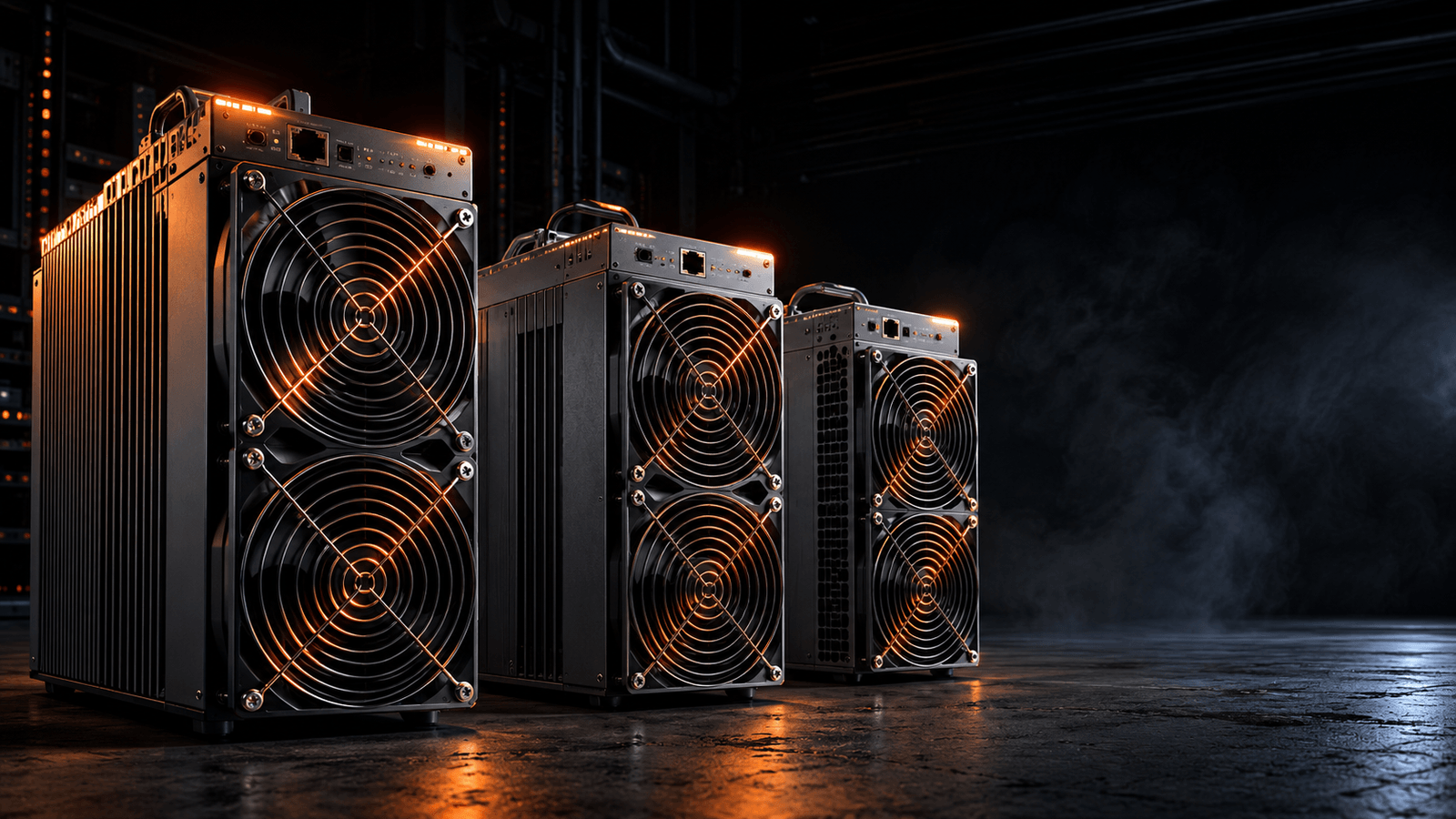
Illustrative image, AI-generated
By Michel Hartleben | CEO, 21 Strategy GmbH | Updated: May 2026
If you want to buy an ASIC miner in 2026, you're looking at a crowded and confusing market: Antminer S21 Pro, S21 XP, S21 XP Hydro, Whatsminer M60S+, M61S+, Sealminer A2 — manufacturers ship new generations every few months, prices range from USD 1,800 to 9,000 per unit, and the spread between hashrate and efficiency is massive.
This buyer's guide gives a clear overview: what an ASIC miner actually is, what really matters when buying one, which current models are worth their price, where the traps are when importing from overseas — and which decision you have to make after the purchase (hosting or self-operation).
Note: This article covers SHA-256 Bitcoin mining hardware only. Altcoin miners (Equihash, Scrypt, Kaspa) are out of scope, because Minenity exclusively offers Bitcoin mining.
What is an ASIC miner?
ASIC stands for Application-Specific Integrated Circuit— a chip built for one single task. In the Bitcoin context that means the ASIC can only compute SHA-256 hashes. That's precisely what Bitcoin mining requires to produce new blocks and earn block rewards.
Compared to earlier mining generations using CPUs or GPUs, ASIC miners are roughly a factor of 100,000 more efficient at Bitcoin mining. A modern gaming GPU would compute for decades to find a single block on its own. A current Antminer S21 XP runs 270 trillion SHA-256 calculations per second (270 TH/s) — and even that is a tiny fraction of the global Bitcoin network.
Anyone serious about Bitcoin mining today needs an ASIC. Anything else simply isn't economically viable.
What an ASIC looks like physically
A modern Bitcoin ASIC miner is a roughly shoebox-sized aluminum enclosure with a built-in power supply, several hashboards (the actual compute units), and two large fans. Weight: 12–18 kg (26–40 lbs). Noise in operation: 70–80 dB — about as loud as a vacuum cleaner. Power draw: 3,000–5,700 W continuous. Anyone running an ASIC at home needs either a basement with proper ventilation or a garage — in living spaces the noise and waste heat are unbearable.
The three things that actually matter when buying an ASIC miner
Three numbers count when picking an ASIC — everything else is marketing noise:
1. Hashrate (TH/s) — how fast does it compute?
Hashrate is the number of SHA-256 calculations per second the miner runs. The unit is terahash per second (TH/s). Higher hashrate means a higher probability of contributing to a block found by your mining pool, which means more Bitcoin earned.
Current SHA-256 miners for Bitcoin range from 200 to 495 TH/s. Hashrate alone says nothing about profitability — what matters is its ratio to power draw.
2. Energy efficiency (J/TH) — by far the most important number
Energy efficiency is measured in joules per terahash (J/TH) and answers the central question: How much electricity does the miner consume per unit of compute? Lower is better.
Examples from the current lineup: the Antminer S21 XP 270T runs at 13.5 J/TH. The older Whatsminer M60S+ sits at 16 J/TH. The S21j XP Hydro 495T pushes down to 12 J/TH — currently the efficiency flagship. That spread from 12 to 17 J/TH translates, in continuous operation over three years, to thousands of EUR difference in electricity per unit.
Rule of thumb: the better the efficiency, the higher the acquisition price. At cheap hosting power (EUR 0.062/kWh) the higher purchase price of an efficient model pays back faster than at expensive residential power (USD 0.17+/kWh in the US, EUR 0.30 in Germany).
3. Price per TH/s — the simple profitability formula
To compare models fairly, divide the purchase price by the hashrate. That gives you the price per terahash. An S21+ 235T at EUR 2,499 comes out to ~EUR 10.60/TH. An S21 XP 270T at EUR 4,199 comes out to ~EUR 15.60/TH. The S21j Hydro 495T at EUR 7,999 is ~EUR 16.20/TH.
At first glance the S21+ looks cheapest. Over the lifetime, though, the more expensive XP can be more economical because its better efficiency lowers the running power bill. This is exactly what our Bitcoin Mining Calculator computes — it combines acquisition cost, power price, hashrate, and current BTC price into a concrete profitability projection.
Current Bitcoin ASIC miners compared
Three manufacturers dominate the Bitcoin mining market: Bitmain (Antminer), MicroBT (Whatsminer), and Bitdeer (Sealminer). Here are the key current models you can buy at Minenity or from other serious distributors:
Antminer — Bitmain
Bitmain is the world's largest Bitcoin mining hardware manufacturer and the de-facto market standard. The S21 series is the current generation.
- Antminer S21+ 235T— 235 TH/s, 3,500 W, 14.9 J/TH. The all-rounder. Solid efficiency, attractive price. Recommended for new operators who don't need the absolute flagship.
- Antminer S21 Pro 234T — 234 TH/s, 3,800 W, 16.2 J/TH. Slightly worse efficiency than the S21+ but very stable in continuous operation. Optimized for professional hosting.
- Antminer S21 XP 270T — 270 TH/s, 3,645 W, 13.5 J/TH. The efficiency champion among air-cooled models. Clear recommendation for anyone planning long-term and prioritizing low operating cost.
- Antminer S21j XP Hydro 495T — 495 TH/s, 5,940 W, 12 J/TH. The flagship with water cooling (released March 2026). Requires specific infrastructure at the hosting site, but offers the highest hashrate per unit and the best efficiency in our lineup.
For a full walkthrough of the S21 family (eight models, release dates, decision matrix), see our complete Antminer S21 guide.
Whatsminer — MicroBT
MicroBT is the second-largest manufacturer. The units have a reputation for ruggedness and hold their resale value well. Slightly worse efficiency than the Bitmain flagships, but more stable firmware.
- Whatsminer M60S+ 206T — 206 TH/s, 3,300 W, 16 J/TH. Proven mid-range miner. Good for hosting setups where reliability matters more than top efficiency.
- Whatsminer M61S+ 220T — 220 TH/s, 3,740 W, 17 J/TH. The newest generation. Slightly higher hashrate than the M60S+, with marginally higher power draw.
Sealminer — Bitdeer
Bitdeer is the youngest of the three large manufacturers but has established itself quickly with the A2 series. The units offer very good efficiency in the mid-range price band.
- Sealminer A2 220T — 220 TH/s, 3,300 W, 15 J/TH. Very good efficiency at a fair price.
- Sealminer A2 222T / 224T — slightly higher hashrate variants with similar efficiency values between 14.7 and 14.9 J/TH.
For direct model comparison with current specs, prices, and availability, see the Minenity miner shop.
New or used? A question of trust
On classified sites, Telegram groups, and mining forums, used ASIC miners regularly pop up at heavily discounted prices. Tempting, but risky.
Upside of buying used
- 20–40 % price discount vs. new units
- Immediately available — no manufacturer lead time
- From serious sellers: often a short remaining warranty
Risks of buying used
- Wear is invisible. A miner that ran 2 years 24/7 has bearing wear on the fans and thermal stress on the hashboards. Failures often only show up after weeks.
- Warranty loss. Bitmain and MicroBT typically only honor warranty for the original buyer. Transfer is usually not possible.
- Modified firmware. Some previous owners overclock their miners with custom firmware (BraiinsOS, VNish). That cuts lifespan drastically — and is rarely disclosed transparently at resale.
- Theft risk. Stolen miners from data center break-ins often end up on secondary markets. In the worst case you end up with a non-working unit and a legal problem.
Our recommendation: For your first miner purchase, buy new from a serious distributor with a warranty and transparent supply chain. Used purchases only make sense once you have enough experience to assess value and condition realistically — and ideally only from known operators with a verifiable mining history.
Spotting a serious distributor — and avoiding scams
The Bitcoin mining market attracts scammers. Prepayment without delivery, counterfeit hardware, fake webshops — the spectrum is wide. Five warning signs worth memorizing:
- Crypto-only payment.Serious distributors offer bank transfer, invoiced payment, and standard payment methods (credit card, ACH, SEPA). A seller who only accepts Bitcoin or USDT is hiding something — there's no chargeback path if things go wrong.
- No business registration, no address, no legal imprint.A serious distributor in any jurisdiction must publish a complete business address, registration number, and contact details. If those are missing, it's not a legitimate business.
- Unrealistically low prices.If an S21 XP 270T is advertised at USD 1,500 while market price is USD 4,000, it's a scam.
- Pressure and artificial scarcity. "Only 2 units left!" or "Price valid today only!" are classic manipulation triggers. Serious hardware suppliers have transparent lead times and stable pricing.
- No support in your language. Vendors who only communicate in Mandarin or Russian and offer no English- or local-language support are not a safe option for Western buyers.
Positive indicators for serious distributors: personal pre-purchase consultation, written purchase contract with delivery terms, warranty handling through a contractual party in your jurisdiction, the option for site inspection or factory visit. At Minenity all of this is standard — 21 Strategy GmbH is your contractual counterparty under German commercial law, fully legally accountable from Berlin.
Import & customs: ordering directly from overseas
Many buyers try to order directly from Bitmain or MicroBT in China — tempted by seemingly lower list prices. What often gets forgotten: the import overhead usually erases the advantage.
What import costs typically look like
- Import VAT / sales tax on the goods value plus shipping plus duty. Rates depend on the destination country (e.g. 19 % VAT in Germany, state-level sales tax in the US).
- Customs duty on data processing equipment: usually 0 % (tariff code 8471) — but depends on the actual code declared by the manufacturer.
- Shipping cost for sea cargo from China to the US or Europe: USD 220–450 per unit. Air freight: USD 650–1,300.
- Customs broker fee: typically USD 110–270 flat.
- Risk: customs hold. Mining hardware can be temporarily detained by customs if documents are incomplete. Resolution can take weeks.
Concrete example: an Antminer S21 XP at a USD 3,000 list price ends up at roughly USD 4,300 all-in after import to Europe or the US. In a best-case scenario that's ~USD 200 cheaper than buying from a local distributor — at significantly higher complexity and zero local warranty service.
Our recommendation: direct import only pays off from bulk orders of 10+ units. For 1–5 miners, buying from a local distributor with a complete logistics package is almost always more economical.
After the purchase: hosting or self-operate?
Once you've bought your ASIC miner, the second big decision kicks in: where does it actually run?
Option A: Self-operation at home
You run the miner in your basement, garage, or industrial facility. Upside: full hardware control, no third-party trust, waste heat can theoretically be used for heating in winter.
Downside: residential power in the US runs USD 0.13–0.18/kWh — and in Europe often EUR 0.25–0.35/kWh. At an S21 XP's 3,645 W continuous draw, that means USD 350–500/month in power. At current network difficulty and BTC around EUR 62,000, a single miner only earns ~EUR 260/month gross. At residential rates that leaves a net loss of roughly USD 200–350 per month, which is why home mining on residential power doesn't pay right now.
On top of that: noise (75–80 dB is a problem for neighbors too), waste heat in summer, regular fan maintenance, pool setup, monitoring — and the legal question of business registration. Anyone who wants to handle this themselves needs time and technical expertise.
Option B: Professional hosting
With hosting you buy the miner and hand it over to an operator like Minenity. We install the unit in one of our data centers in the USA or Asia, connect it to the ViaBTC mining pool, and handle power, cooling, maintenance, and 24/7 monitoring. You retain 100 % ownership of the miner and receive Bitcoin directly into your own wallet.
Upside: power from EUR 0.062/kWh (Asia hydropower) or EUR 0.066/kWh (USA) — a fraction of residential rates. You're also rid of the noise, the waste heat, and the maintenance work. Professional infrastructure with contractual 97 % uptime. Direct personal contact through 21 Strategy GmbH in Germany as your counterparty.
Downside: you have to trust the operator. The hardware sits physically in the USA or Asia, not at home. It can be retrieved on request, but the logistics overhead is meaningful.
More on hosting locations, pricing, and contract terms on the Bitcoin Mining Hosting overview.
Which option fits whom?
- 1 miner for testing, basement with ventilation, very low power tariff (e.g. your own oversized PV array): self-operation can make sense.
- 2+ miners, investment intent, professional setup required: hosting is almost always more economical.
- Commercial operation with depreciation as part of the structure: hosting with a contractual counterparty in your jurisdiction is the clean model — the hardware remains your fixed asset, hosting fees are operating expenses.
Frequently asked questions on buying an ASIC miner
What does a good ASIC miner cost in 2026?
Current mid-range units like the Antminer S21+ 235T or Whatsminer M60S+ sell for USD 2,200–3,100. Efficiency flagships like the S21 XP 270T sit around USD 4,000–4,200. Hydro units for professional hosting setups reach USD 7,700 and up. Below USD 1,700 you typically only get outdated previous-generation hardware with much worse efficiency.
How long does an ASIC miner last?
In professional hosting with controlled cooling and power, lifespan is 3–5 years. In self-operation without climate control, more like 2–3 years. The limiting factors are usually fans and power supply — hashboards typically last longer.
Which ASIC miner is the best in 2026?
Depends on the use case. For maximum efficiency: Antminer S21j XP Hydro 495T (12 J/TH, water-cooled). For best price-to-performance: Antminer S21+ 235T. For maximum hashrate-per-unit in an air-cooled setup: Antminer S21 XP 270T. For proven ruggedness over peak specs: Whatsminer M60S+ 206T.
Can I be profitable with a single ASIC miner?
At current BTC prices and cheap hosting power (EUR 0.062/kWh): yes, with a thin but positive margin. At residential power (USD 0.17/kWh or higher): only if the BTC price moves up significantly or network difficulty drops — both unpredictable. The concrete profitability for your preferred model is best run through our Bitcoin Mining Calculator.
Where can I buy an ASIC miner from a serious source?
Directly from the manufacturer (Bitmain, MicroBT, Bitdeer) with import overhead and customs risk. Or from a local distributor like Minenity with proper invoicing, warranty handling, and personal consultation. We ship to the DACH region and Europe and, on request, hook the miner up directly to our hosting service.
Conclusion: what really matters when buying an ASIC miner
If you're buying a Bitcoin ASIC miner in 2026, don't get distracted by raw hashrate numbers. What matters is efficiency in J/TH— that's what decides, in continuous operation over three years, whether the investment earns money or burns it.
Equally important is the question of the operating model. Home mining only works at very cheap dedicated power — typically your own PV array or an industrial contract. Without that, professional hosting is the economically better path. The delta between EUR 0.062/kWh hosting power and EUR 0.30/kWh residential power, over three years of lifespan on a 3,500 W miner, adds up to more than EUR 20,000 per unit — more than the acquisition cost of the device itself.
And third: don't buy blind. Get advice, get a written quote with full specs, and run the distributor against the five scam indicators above. A good ASIC purchase is a multi-year investment — the few hours spent on proper due diligence are well spent.
At Minenity we advise every client personally before purchase, and we recommend the model that fits your budget and use case, not the most expensive one. And if you want, we take care of hosting too, in our data centers in the USA or Asia.
More from Bitcoin Knowledge
Interested? Talk to us.
At Minenity we advise entrepreneurs, family offices, and high-net-worth individuals personally. European contracts, transparent billing, and a team that speaks your language.
About the author: Michel Hartleben is the founder and managing director of 21 Strategy GmbH (Berlin) and the brand Minenity. He advises private investors and family offices on bitcoin mining hosting strategy, hardware selection, and treasury allocation.