Antminer S21: The Complete Guide to Bitmain's S21 Mining Series (2023–2026)
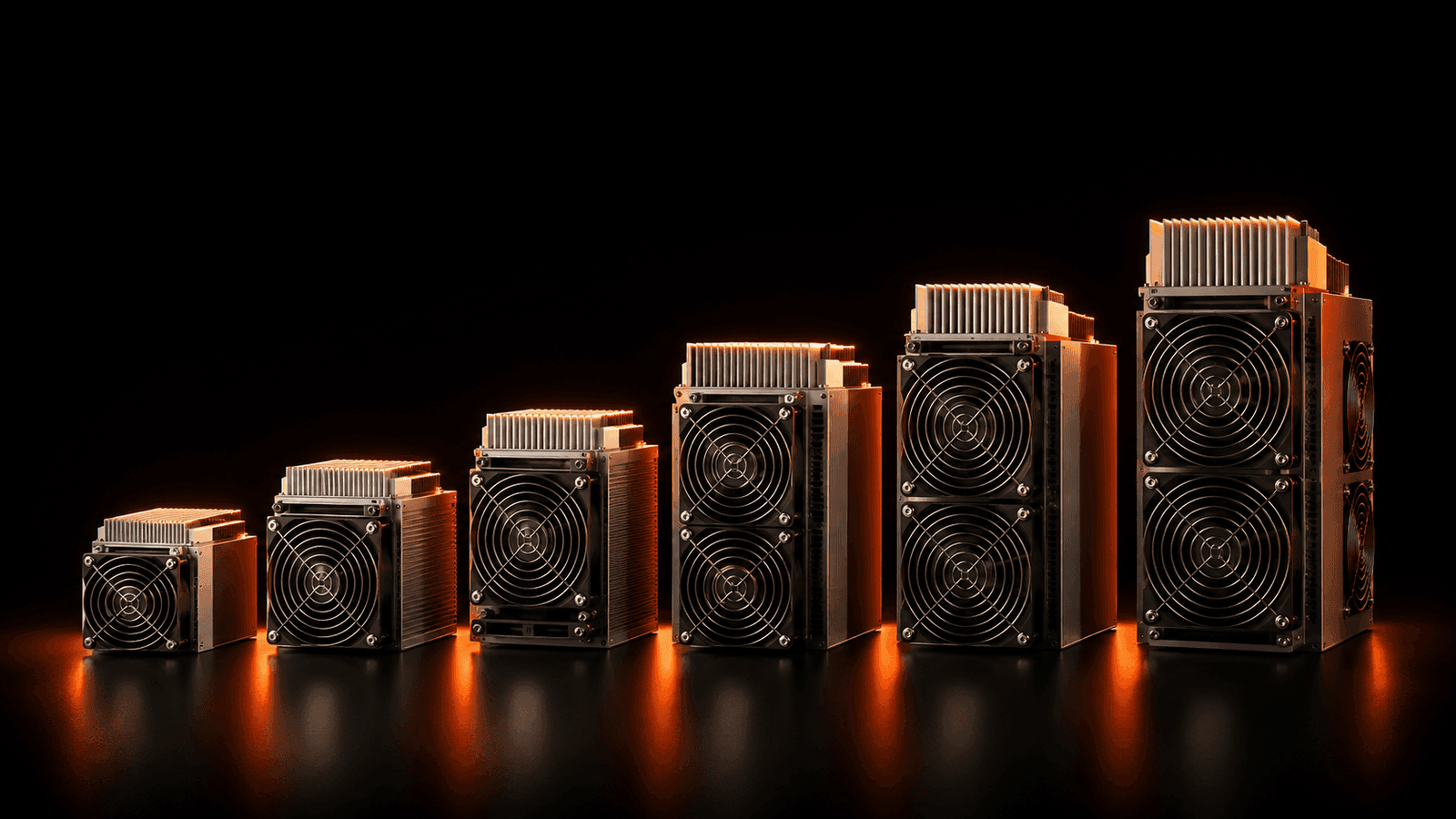
Illustrative image, AI-generated
Quick summary:Bitmain's Antminer S21 series debuted in August 2023 and has expanded into a family of eight distinct models with hashrates between 200 and 500 TH/s and efficiencies between 17.5 and 11 J/TH. In this guide we walk through each model in release order, with the real specifications and a clear answer to the question that matters: which one is right for you?
Introduction: why the S21 series was a turning point
When Bitmain unveiled the first Antminer S21 at the World Digital Mining Summit in Hong Kong in September 2023, the industry was months away from the fourth Bitcoin halving. Every miner knew the margin was about to tighten — the block reward would drop from 6.25 to 3.125 BTC in April 2024 — and that only the most efficient ASICs would survive.
The S21 was Bitmain's answer. At an efficiency of 17.5 J/TH, it was the first SHA-256 ASIC to break below the 20 J/TH barrier, a 24 % improvement over the Antminer S19 XP (21.5 J/TH) that had dominated the previous cycle.
What started as a single model has become a complete family. As of mid-2026, the S21 series includes eight official variants — from the base model to the hydro-cooled 500 TH/s flagship. All eight run on 5-nanometer SHA-256 chips, and every iteration has pushed energy efficiency further down.
This article walks through each model in release order with real specifications, concrete dates, and — most importantly — the practical answer: which one is right for you?If you're still earlier in the decision and want the big-picture view on whether mining makes sense in 2026 at all, start with our honest profitability analysis.
Origin of the series: the 2024 halving context
The S21 series didn't come out of nowhere. Bitmain had been working with TSMC since 2022 on a new generation of 5 nm chips, aware that the April 2024 halving would force a global transformation of the mining fleet.
The Antminer S21 air-cooled and S21 Hydro models were both introduced at Bitmain's World Digital Mining Summit 2023 in Hong Kong. The official S21 release date was August 14, 2023, although the first real units only started shipping in Q1 2024.
Three factors explain why the S21 quickly dominated the market:
- Real technological advantage: the move to the BM1366 chip (5 nm) was the first significant optimization since the S19 XP in 2022.
- Mass production capacity: Bitmain announced production capacity of at least 50,000 units per month over the first eight months — enough to supply the large publicly listed North American miners.
- Perfect timing: first deliveries coincided with the pre-halving Bitcoin rally, which justified the investment economically even at launch prices.
From that starting point, Bitmain extended the family with seven additional models — each with a specific performance, efficiency, or cooling target.
Antminer S21 (original, August 2023)
The base model. The one that opened the series and is, in many ways, still the reference point.
| Specification | Value |
|---|---|
| Release date | August 14, 2023 |
| Hashrate | 200 TH/s |
| Power draw | 3,500 W |
| Efficiency | 17.5 J/TH |
| Cooling | Air (dual fan) |
| Chip | BM1366 (5 nm) |
| Weight | 18 kg |
| Dimensions | 195 × 290 × 400 mm |
| Algorithm | SHA-256 |
Who's it for? Miners looking for the best balance between acquisition price and operating efficiency. It's the workhorse of many installations — secondary-market prices have come down meaningfully since launch, which makes it attractive for starting an operation without paying the flagship premium.
Weak point:at 17.5 J/TH it's no longer the most efficient model in the series. At higher electricity rates (> USD 0.10/kWh) the later models pay back faster.
Antminer S21 Hyd (liquid cooling, late 2023)
Released alongside the base S21, the Hyd was Bitmain's bet on liquid cooling for the new generation.
| Specification | Value |
|---|---|
| Release date | Q4 2023 |
| Hashrate | 335 TH/s |
| Power draw | 5,360 W |
| Efficiency | 16 J/TH |
| Cooling | Hydro (closed-loop liquid) |
| Chip | BM1366 (5 nm) |
At launch, the air-cooled model had a promotional price of USD 14/TH for orders of 1.2 EH/s or more — equivalent to USD 2,800 per unit for the air-cooled models and USD 4,690 per unit for the hydro versions.
Who's it for? Operators with existing water infrastructure, or those building a data center from scratch with hydro planning. Liquid cooling enables much higher rack densities and drastically reduces noise — but requires significant upfront investment in Coolant Distribution Units (CDUs).
Antminer S21 Immersion (July 2024)
A variant specifically designed for data centers using dielectric immersion cooling.
| Specification | Value |
|---|---|
| Release date | July 1, 2024 |
| Hashrate | 215 TH/s |
| Power draw | 3,440 W |
| Efficiency | 16 J/TH |
| Cooling | Immersion (dielectric) |
| Dimensions | 236 × 293 × 364 mm |
Immersion delivers two things air can't: near-perfect thermal dissipation (chips run cooler, extending lifespan) and silent operation (noise drops to barely perceptible levels).
Who's it for?Almost exclusively industrial operators with immersion tanks already in place. For private or small-scale miners, the infrastructure complexity doesn't pay off.
Antminer S21 Pro (October 2024)
The first generational leap within the family, powered by the new BM1370 chip.
| Specification | Value |
|---|---|
| Release date | October 2024 |
| Hashrate | 220 / 234 / 245 TH/s (three variants) |
| Power draw | 3,300 – 3,675 W |
| Efficiency | 15 J/TH |
| Cooling | Air |
| Chip | BM1370 (5 nm) |
The S21 Pro family ships in three hashrate configurations — 220, 234, and 245 TH/s — all with the same 15 J/TH nominal efficiency. The 234 TH/s configuration is the most common on the secondary market.
The Pro fixes the base S21's main weakness: efficiency. Moving from 17.5 to 15 J/TH means 14 % less electricity per terahash — and at industrial scale that adds up to thousands of EUR per year per unit.
Who's it for?Probably the most balanced option in the series today: more efficient than the base S21 without the complexity of hydro models. If you're buying a single miner for professional hosting, the S21 Pro is hard to beat.
Want to calculate profitability for your case? Use the Bitcoin Mining Calculator with the model and your electricity cost.
Antminer S21 XP (October 2024)
The air-cooled flagship of the generation. Same launch as the Pro, but a step above in performance.
| Specification | Value |
|---|---|
| Release date | October 2024 |
| Hashrate | 270 TH/s |
| Efficiency | 13.5 J/TH |
| Cooling | Air |
| Chip | BM1368 (5 nm) |
The Antminer S21 XP (270 TH/s) is built around the BM1368 chip (also 5 nm). Compared to the S19 XP (21.5 J/TH), the S21 XP (13.5 J/TH) operates 60 % more efficiently.
Who's it for? Operators who want maximum performance without committing to hydro infrastructure. It offers the best hashrate-per-rack-space ratio in air.
Antminer S21 XP Hyd (October 2024)
The hydro-cooled flagship of the generation. A qualitative leap compared to the original S21 Hyd.
| Specification | Value |
|---|---|
| Release date | October 2024 |
| Hashrate | 473 TH/s |
| Power draw | 5,676 W |
| Efficiency | 12 J/TH |
| Cooling | Hydro (closed-loop) |
| Chip | BM1370 (5 nm) |
| Weight | 12.8 kg |
| Warranty | 365 days |
The Hyd delivers 75 % more hashrate and 11 % better efficiency than its air-cooled equivalent. The trade-off is complexity: the S21 XP air-cooled runs on standard single-phase 220–277 V and only needs power and internet, while the Hyd requires full water-cooling infrastructure.
Who's it for? Serious operations in CDU-equipped data centers. For professional hosting with hydro infrastructure available — like our data centers in the USA and Asia — the S21 XP Hyd offers the best cost-per-terahash on the market.
Antminer S21+ (February 2025)
The iterative update of the base S21, released fourteen months later.
| Specification | Value |
|---|---|
| Release date | February 2025 |
| Hashrate | 216 – 235 TH/s |
| Power draw | 3,564 – 3,878 W |
| Efficiency | 16.5 J/TH |
| Cooling | Air |
Launched in February 2025, the S21+ increases hashrate from 200 TH/s to a solid 216–235 TH/s, with power draw of 3,564 W to 3,878 W depending on the selected hashrate mode. It features dual-fan cooling and a robust thermal management system, operating between 10 and 40 °C with noise levels capped at 75 dB.
Who's it for?The S21+ is for miners who want a newer model than the original S21 but don't want to pay Pro-level pricing. Its efficiency (16.5 J/TH) sits between the base S21 and the S21 Pro.
Antminer S21 XP+ Hyd (Q2 2025)
The most recent model in the family and, as of today, the most efficient unit in the series.
| Specification | Value |
|---|---|
| Release date | Q2 2025 |
| Hashrate | 500 TH/s |
| Power draw | 5,500 W |
| Efficiency | 11 J/TH |
| Cooling | Hydro (advanced closed-loop) |
While the standard S21 XP Hydro delivers 473 TH/s at 5,676 W (12 J/TH), the S21 XP+ Hyd pushes performance to 500 TH/s at 5,500 W (11 J/TH) — roughly 5 % improvement on both hashrate and efficiency. The miner uses an advanced closed-loop liquid cooling system. Coolant circulates through cold plates that sit directly on the ASIC chips, keeping core temperatures between 42 and 45 °C.
Who's it for?Industrial operations that want the best efficiency in the S21 family and plan to operate the unit through the next halvings (2028, 2032). On very cheap electricity (≤ EUR 0.06/kWh) and a long horizon, it's the most defensive investment.
Complete comparison table
| Model | Release | Hashrate | Power | Efficiency | Cooling |
|---|---|---|---|---|---|
| S21 | Aug 2023 | 200 TH/s | 3,500 W | 17.5 J/TH | Air |
| S21 Hyd | Q4 2023 | 335 TH/s | 5,360 W | 16 J/TH | Hydro |
| S21 Immersion | Jul 2024 | 215 TH/s | 3,440 W | 16 J/TH | Immersion |
| S21 Pro | Oct 2024 | 220–245 TH/s | 3,300–3,675 W | 15 J/TH | Air |
| S21 XP | Oct 2024 | 270 TH/s | ~3,645 W | 13.5 J/TH | Air |
| S21 XP Hyd | Oct 2024 | 473 TH/s | 5,676 W | 12 J/TH | Hydro |
| S21+ | Feb 2025 | 216–235 TH/s | 3,564–3,878 W | 16.5 J/TH | Air |
| S21 XP+ Hyd | Q2 2025 | 500 TH/s | 5,500 W | 11 J/TH | Hydro |
The chips behind the series: BM1366, BM1368, BM1370
The differences between the models come down to the silicon, not the chassis or the fans.
The Antminer S21 Pro (15 J/TH) and S21+ (16.5 J/TH) are powered by the BM1370 chip on 5 nm. The Antminer S21 XP (270 TH/s) uses the BM1368 (also 5 nm), which sits between the BM1366 and the BM1370.
For scale, it's worth looking back: the BM1397 chips (7 nm) in the Antminer S19 Pro delivered 29.5–34 J/TH, and the S19 XP later reached 21.5 J/TH. The BM1366 (5 nm) in the original S21 then pushed the barrier down to 17.5 J/TH.
In four years, Bitmain cut power per terahash by more than 60 %. That improvement explains why most of the large publicly listed miners have completely migrated to the S21 generation over the 2024–2026 cycle.
Which Antminer S21 is right for you?
Here's the honest answer: it depends on three of your variables, not the miner's.
| Your situation | Recommended model | Why |
|---|---|---|
| First miner, tight budget, professional hosting | S21 base | Best price-to-efficiency on the secondary market |
| Planned investment (1–3 units) in hosting | S21 Pro | Improved efficiency without hydro complexity |
| No budget ceiling, air-cooled hosting, maximum performance | S21 XP | Air-cooled flagship |
| Professional hosting with hydro infrastructure available | S21 XP Hyd or XP+ Hyd | Best cost per TH/day on the market |
| Own data center with immersion tank | S21 Immersion | Specifically designed for that infrastructure |
| Recent hardware without the Pro premium | S21+ | 2025 iteration of the base model |
A practical rule of thumb we use in advisory:
- Electricity ≤ EUR 0.07/kWh: any model in the series is profitable. Optimize for acquisition price.
- Electricity between EUR 0.07 and 0.12/kWh: prioritize efficiency. S21 Pro or above.
- Electricity > EUR 0.12/kWh:only XP, XP Hyd, or XP+ Hyd. Above 13.5 J/TH it's hard to recoup the investment.
Practical reference: In our Minenity data centers in the USA and Asia, all-in hosting power cost for clients starts at EUR 0.062/kWh. At that rate, virtually any S21 model is profitable over its useful life.
Why an S21 and not an S19?
A legitimate question: Antminer S19 (7 nm) units now sell on the secondary market for a fraction of the S21 price. Why not buy a used S19j Pro for USD 650 instead of an S21 base at USD 2,700?
The answer is in the halving math. Following the 2024 halving, the block reward dropped to 3.125 BTC. S19 Pro units at 29.5 J/TH are only profitable at electricity below USD 0.055/kWh — a rate most operators can't achieve even in professional hosting. S21 units at 17.5 J/TH (or better) have a much wider margin of safety.
Simple rule:if you plan to operate the miner over the next four years (through the 2028 halving), buy S21. If you're only looking for short Bitcoin exposure with existing hardware, an S19 on very cheap power may still work — but difficulty risk is high.
How to buy and host an Antminer S21
The typical workflow, from decision to first hash, looks like this:
- Pick the model based on your profile (see matrix above).
- Request a quote for both purchase and hosting from the same provider — it saves logistics, shipping cost, and setup time.
- Sign the invoice and contractin your name or your entity's name. For tax purposes in most jurisdictions, invoicing to a corporate entity is the cleaner approach.
- The provider installs the miner in the data center (24–72 hours).
- Provide your wallet address — operation runs via the ViaBTC pool, Bitcoin goes directly to your address.
- Receive monthly power invoices based on actual miner consumption.
At Minenity we sell the entire S21 family with optional integrated hosting in our data centers in the USA and Asia. To check current availability and pricing, browse the catalog or jump directly to the Antminer S21 XP 270T product page.
On the hardware ownership question — and why owning the asset beats renting hashrate — see our piece on bitcoin mining for family offices and HNW investors.
Conclusion: the S21 series in perspective
What started in August 2023 with a single 200 TH/s model has, in less than two years, become the most complete ASIC family in the SHA-256 market. Eight models, from the individual miner with USD 3,000 to the industrial operation with thousands of immersion units.
The S21 series accomplishes the goal Bitmain set after the 2024 halving: extending the profitability horizon for Bitcoin mining to operators paying industrial electricity rates — not just the megaprojects with their own power. At 11 J/TH, the S21 XP+ Hyd needs 37 % less energy per terahash than the original S21 did less than two years earlier.
For 2026 and through the next halving in 2028, S21 units will make up a large share of the network's installed hashrate. Picking the right model within the family — matched to your electricity and time horizon — is probably the single most important decision you'll make as a miner in this cycle.
Frequently asked questions
What's the difference between the Antminer S21 and the S21 Pro?
The base S21 (August 2023) is 200 TH/s at 17.5 J/TH efficiency. The S21 Pro (October 2024) is 220–245 TH/s at 15 J/TH — 14 % more efficient. The difference translates to roughly EUR 200 less in electricity per miner per year at industrial rates.
How much does an Antminer S21 cost in 2026?
Secondary-market pricing varies meaningfully with supply and demand. As a reference: the base S21 runs around USD 2,200–3,100 in 2026, the S21 Pro between USD 3,800 and 5,500, the S21 XP Hyd between USD 7,700 and 11,000. For up-to-date pricing see our shop.
Is the Antminer S21 still profitable after the 2024 halving?
Yes — on industrial electricity. With power below USD 0.075/kWh, every S21 model generates positive cash flow. The problem isn't the halving; it's residential power at USD 0.17+/kWh. That's why nearly every professional miner operates in hosting.
How much electricity does an Antminer S21 use per month?
The base S21 (3,500 W) draws roughly 2,520 kWh per month running 24/7 (3.5 kW × 24 h × 30 days). At EUR 0.062/kWh in hosting, that's about EUR 156 per month. The S21 XP+ Hyd (5,500 W) draws around 3,960 kWh per month — about EUR 245 at the same rate.
Can I retrofit an air-cooled S21 with a hydro system?
Not in any supported way. Standard S21 series units use air cooling; the specialized immersion / hydro variants are available through authorized distributors. Standard S21 models should not be modified for liquid cooling without Bitmain-approved conversion kits. A homebrew conversion voids the warranty and risks damaging the hardware.
Which chip does each Antminer S21 use?
The original S21 and the S21 Hyd use the BM1366 chip. The S21 XP uses the BM1368. The newer models — S21 Pro, S21 XP Hyd, S21+, S21 XP+ Hyd — use the flagship BM1370. All are 5 nm processes manufactured at TSMC.
How much Bitcoin will I mine with an Antminer S21?
It depends on network difficulty and the Bitcoin price, both of which fluctuate. As a reference (mid 2026, difficulty ~138 T), a base S21 mines roughly 0.0025 BTC per month; an S21 XP Hyd mines around 0.006 BTC per month. For an estimate using your real parameters, use the calculator.
How long does an Antminer S21 last?
The technical lifespan of a well-cooled ASIC typically exceeds 5 years. Economic lifespan depends on the next halving and network difficulty. As a practical rule, an S21 purchased in 2026 should be profitable at least through the 2028 halving, and probably beyond if electricity stays below EUR 0.07/kWh.
What warranty does an Antminer S21 come with?
Bitmain offers a 365-day standard warranty for new units sold through authorized channels. Some distributors like Minenity offer additional warranty extensions for hosting clients. Secondary-market units typically come without manufacturer warranty.
About the author
Michel Hartleben is the founder and managing director of 21 Strategy GmbH (Berlin), parent of the Minenity brand. He advises private investors and family offices on bitcoin mining hosting strategy, hardware selection, and treasury allocation.
Disclaimer: this article is for informational purposes only and does not constitute financial, tax, or investment advice. Hardware specifications are based on publicly available manufacturer information as of mid-2026 and may change. Mining profitability depends on variables outside the operator's control (Bitcoin price, network difficulty, electricity costs) and is not guaranteed.
More from Bitcoin Knowledge
Interested? Talk to us.
At Minenity we advise entrepreneurs, family offices, and high-net-worth individuals personally. European contracts, transparent billing, and a team that speaks your language.
About the author: Michel Hartleben is the founder and managing director of 21 Strategy GmbH (Berlin) and the brand Minenity. He advises private investors and family offices on bitcoin mining hosting strategy, hardware selection, and treasury allocation.