Bitcoin Mining Hosting vs. DIY: The Honest Cost Comparison in 2026
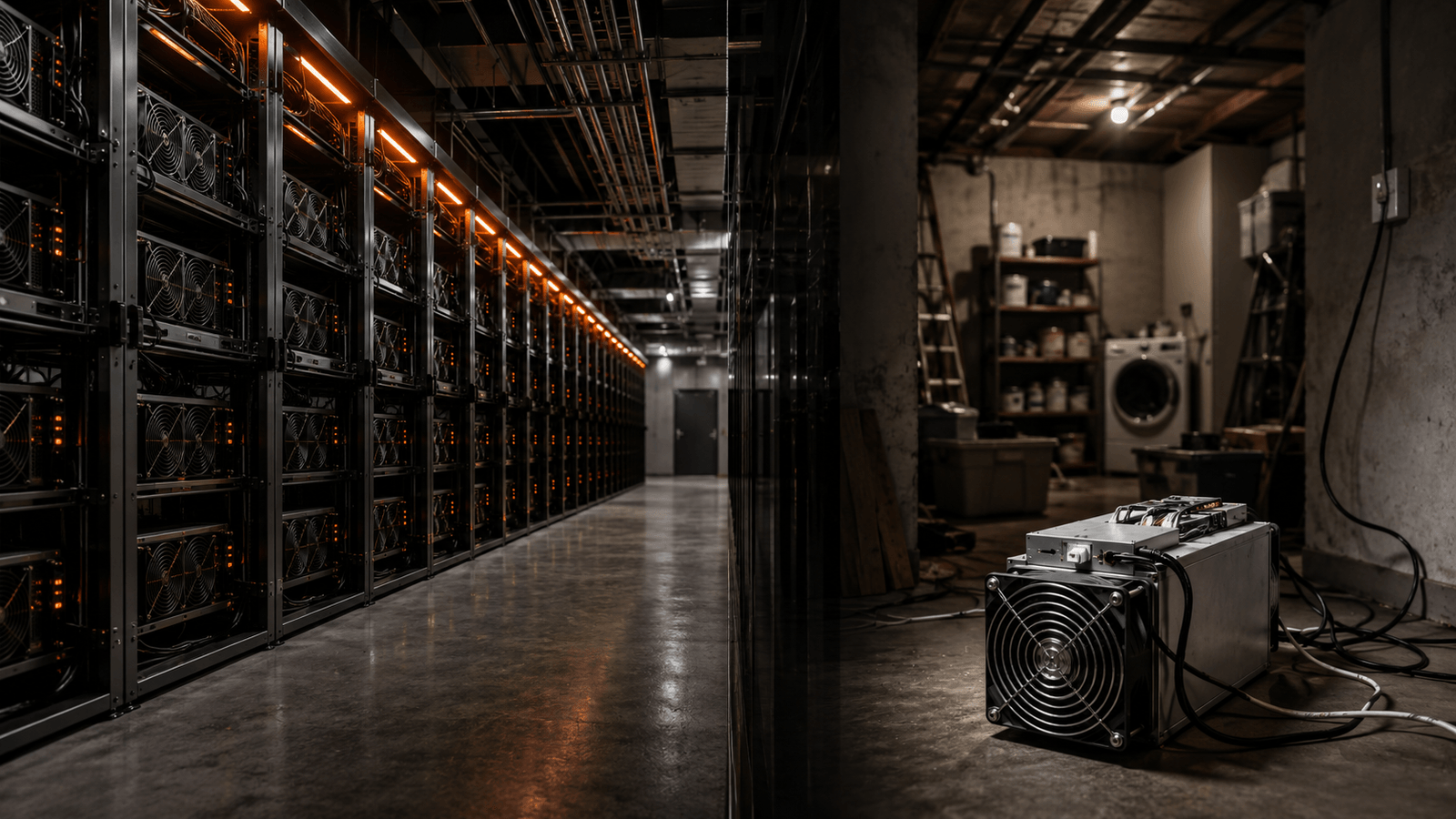
Illustrative image, AI-generated
By Michel Hartleben | CEO, 21 Strategy GmbH | Updated: May 2026
Anyone buying an ASIC miner is immediately facing the second big decision: run it yourself at home, or let a professional data center host it? This choice decides the economics of the entire investment: the difference runs to thousands of EUR per year, per unit.
This article runs the numbers for both options with concrete scenarios — 1, 5, and 10 miners — and lays out what you actually get with professional hosting, where the typical pitfalls are, and how to identify a serious provider. Cloud mining gets a section too, though as a warning rather than an option.
Note:All calculations are based on May 2026 data with BTC at ~EUR 62,000 (~USD 67,000), current network state and standard hosting tariffs. Margins move with price; the structural conclusions on the cost side don't.
What is Bitcoin mining hosting?
Bitcoin mining hosting (also called "ASIC hosting" or "Bitcoin colocation" in industry parlance) means: you buy the miner and own the hardware 100 %, but the unit doesn't run in your basement — it runs in a service provider's professional data center. You pay a monthly fee (usually per kWh of power consumption) and get location, power feed, cooling, network connectivity, maintenance, and 24/7 monitoring in return.
The mined Bitcoin flows directly to your own wallet. The hosting provider never sees the Bitcoin — they only provide the infrastructure. This is what makes mining hosting fundamentally different from cloud mining, where you only buy a hashrate contract and never own physical hardware (more on that below).
The distinction: hosting vs. cloud mining vs. DIY
- DIY / home mining: Your hardware, your location, your power. Maximum control, highest operational overhead, typically the most expensive electricity.
- Mining hosting: Your hardware, hosted in a professional data center. You pay power plus a service margin, and in return get industrial-grade electricity prices and no operational overhead.
- Cloud mining: No hardware. You just buy a hashrate contract. High risk — see the warning section further below.
The cost comparison: hosting vs. DIY
Power is, by a wide margin, the biggest running cost in Bitcoin mining. An honest side-by-side quickly shows why hosting wins for almost every operator.
Power costs side by side
| Setup | Power rate | Cost / year (S21 XP 270T, 3,645 W) |
|---|---|---|
| DIY US residential | USD 0.17/kWh | ~EUR 4,950 |
| DIY US small business | USD 0.13/kWh | ~EUR 3,780 |
| DIY with PV (peak hours only) | variable | Partial coverage — not 100 % achievable |
| Hosting USA (Minenity) | EUR 0.066/kWh | ~EUR 2,108 |
| Hosting Asia (Minenity, hydropower) | EUR 0.062/kWh | ~EUR 1,980 |
The annual delta between US residential and Asia hosting is about EUR 2,970 per unit. Over 5 units: EUR 14,850/year. Over a typical 3-year hardware lifecycle: ~EUR 44,500. That's more than the acquisition cost of 5 brand-new units.
Beyond power: the hidden DIY costs
Anyone framing the comparison purely in kWh terms is missing the second cost dimension. Self-hosting drags in costs that hosting already prices in:
- Noise abatement: An ASIC runs at 75–80 dB — comparable to a vacuum cleaner running 24/7. Without a basement you need a soundproof enclosure or a dedicated container. Cost: USD 600–3,500.
- Exhaust and cooling: 3,500 W of power draw means 3,500 W of waste heat. In summer you need active ventilation or cooling — otherwise the hashboards throttle and performance drops. A professional ventilation solution runs USD 1,200–4,500 upfront plus ongoing power.
- Electrical service capacity: An S21 XP draws 16 A continuous at 230 V (or ~30 A at 120 V). Three units in parallel saturate most US residential service panels. A panel upgrade or sub-panel installation runs USD 2,000–8,000 and requires utility approval.
- Your own time for maintenance:swapping fans, firmware updates, pool setup, debugging outages. Even at just 1 hour per week per unit: at typical professional hourly rates that's USD 100–250/month in opportunity cost.
Concrete scenarios: 1, 5, and 10 miners
Theoretical numbers say little. Three realistic scenarios, run end-to-end. Assumption: Antminer S21 XP 270T at 3,645 W, BTC at EUR 62,000, current network difficulty.
Scenario 1: One miner
You want to "try mining" — a single Antminer S21 XP 270T. Hardware in Minenity Asia hosting: ~EUR 3,700. Power draw: 3,645 W (~2,625 kWh per month).
At current network difficulty and BTC around EUR 62,000, a single S21 XP produces ~EUR 260 gross per month. That's pure mining revenue before any power cost.
- DIY US residential (USD 0.17/kWh):Power cost ~EUR 410/month. Against EUR 260 in gross revenue, that's a loss of ~EUR 150/month — before maintenance, wear, and tax. Self-hosting on residential rates is structurally unprofitable.
- Hosting USA (EUR 0.066/kWh, all-in): Power ~EUR 175/month. Net margin ~EUR 85/month. The miner actually produces cash flow instead of burning it.
- Hosting Asia hydropower (EUR 0.062/kWh, all-in): Power ~EUR 163/month. Net margin ~EUR 95/month. Over a year that's ~EUR 1,140 in positive cash flow plus the accumulated Bitcoin as a hard asset.
Single-unit verdict: At one device, location is the only thing that decides whether mining produces cash flow at all. Hosting runs with a small but stable positive margin. DIY on US residential power is not viable. Exceptions: your own industrial power below USD 0.08/kWh, or a heavily oversized PV array with strong base-load coverage. To grow margin, you either lever the BTC price (see sensitivity table below) or grow setup volume.
Scenario 2: Five miners — semi-professional setup
At five units we're past hobby. Acquisition 5 × S21 XP 270T in Asia hosting: ~EUR 18,500. Combined draw: 18.2 kW continuous. Gross revenue at current difficulty and EUR 62,000 BTC: ~EUR 1,315/month.
- DIY US residential (USD 0.17/kWh): Power ~EUR 2,050/month. Result: ~EUR 735 monthly loss — before maintenance. On top: service panel upgrade (~USD 5,000), proper ventilation (~USD 3,000), possibly a dedicated room or container. Infrastructure cost beyond the power bill quickly hits USD 10,000–15,000 — just to be allowed to run hardware that loses money every month.
- Hosting USA (EUR 0.066/kWh, all-in): Power ~EUR 870/month. Against EUR 1,315 in gross revenue: net margin ~EUR 445/month, ~EUR 5,350/year cash flow plus the accumulated Bitcoin.
- Hosting Asia (EUR 0.062/kWh, all-in): Power ~EUR 815/month. Net margin ~EUR 500/month, ~EUR 6,000/year cash flow. You also avoid the service panel upgrades, DIY cooling, and noise that come with a home setup.
5-miner verdict: At this size DIY is economically excluded in most jurisdictions unless you already have an industrial facility with high-amp service and a direct tariff under USD 0.08/kWh. Hosting at current bear-market prices is cash-flow positive — but the real return story is the accumulated BTC position over 2–4 years.
Scenario 3: Ten miners — semi-institutional scale
Ten S21 XP units mean 36.5 kW continuous load. Hardware in Asia hosting: ~EUR 37,000 (10 × 3,700). To trim hardware cost, you can mix in cheaper models like the S21+ 235T (~EUR 2,500 in Asia hosting), bringing total acquisition to roughly EUR 25,000 — at proportionally lower hashrate.
Gross revenue at 10 × S21 XP, BTC at EUR 62,000: ~EUR 2,630/month. Asia hosting power ~EUR 1,625, net margin ~EUR 1,000/month (~EUR 12,000/year). US hosting net: ~EUR 880/month. DIY at this scale outside existing industrial infrastructure is impossible — permitting, insurance, and personnel make it uneconomical.
In hosting, 10+ units typically unlock negotiated tariffs: discounted power rates, dedicated points of contact, optionally your own rack section. Anyone deploying 10+ units as a family office, business, or HNW investor has hosting as the clearly superior path — and gains negotiating leverage on power with every additional unit.
How margins move with the BTC price
Mining margins are directly proportional to the BTC price. Same setup as above (S21 XP 270T, 3,645 W, current difficulty), gross and net margin at Minenity Asia hosting (EUR 163/month power, all-in) at different price points:
| BTC price | Gross / month | Net Asia hosting | 5 miners net | 10 miners net |
|---|---|---|---|---|
| EUR 50,000 (deep bear) | ~EUR 200 | +EUR 35 | +EUR 175 | +EUR 350 |
| EUR 62,000 (today) | ~EUR 260 | +EUR 95 | +EUR 475 | +EUR 950 |
| EUR 80,000 (moderate recovery) | ~EUR 320 | +EUR 155 | +EUR 775 | +EUR 1,550 |
| EUR 100,000 (previous ATH) | ~EUR 405 | +EUR 240 | +EUR 1,200 | +EUR 2,400 |
| EUR 150,000 (bull-case post-halving) | ~EUR 605 | +EUR 440 | +EUR 2,200 | +EUR 4,400 |
The key takeaway: even at a deep-bear EUR 50,000 print, the professionally hosted setup stays slightly cash-flow positive, while DIY at residential rates is deeply underwater in every scenario. In the bull case, hosting margins scale linearly with the price. The real lever, though, is the accumulated BTC at the next halving (April 2028).
Run the numbers for your own setup in our Bitcoin Mining Calculator with live difficulty.
What you actually get with professional hosting
Mining hosting is more than "power plus a rack". A serious provider delivers:
- Industrial power feed: Stable supply with redundancy, professional voltage regulation, often UPS or generator backup.
- Climate-managed cooling: Air cooling with directional airflow, water cooling for hydro units, year-round stable operating temperatures.
- 24/7 monitoring: Live hashrate and temperature tracking, automatic alerts on outages, reaction times in hours, not days.
- Pool setup and wallet routing: The provider configures the miners so Bitcoin pays out directly to your own wallet. At Minenity this is the default — you retain full control over your Bitcoin.
- Maintenance and hardware service: Fan swaps, PSU replacement, RMA handling for warranty claims. At Minenity the warranty path runs through 21 Strategy GmbH in Germany as your contractual counterparty.
- Transparent billing: Monthly invoices in EUR with detailed line items, VAT (where applicable) deductible for businesses, clean separation between power consumption and service margin.
A serious hosting platform guarantees 97 % uptime contractually — the industry standard. Higher numbers (99.9 % or similar) sound good but aren't realistically achievable with mining hardware given power outages, network hiccups, and occasional hardware defects. Anyone promising more is either unrealistic or accounting for downtime differently.
Warning: cloud mining is NOT hosting
An important distinction that isn't always made clearly. Cloud mining gets lumped together with hosting — but the two models have almost nothing in common.
How cloud mining works (or doesn't)
With cloud mining you don't buy a miner. You buy a contract that promises a certain hashrate for a certain duration. The provider claims to operate mining hardware somewhere, and your share of the proceeds gets paid out.
Problems with this model:
- No ownership. You own nothing physical. If the provider goes bankrupt or disappears, your money is gone.
- No transparency.You can't verify whether the promised hashrate actually exists. Many cloud mining platforms in the past were pure Ponzi schemes — payouts came from new customer deposits, not from actual mining.
- Poor returns even in best case. When a cloud mining provider actually runs mining, they keep a large share of proceeds as service margin. The effective return to the customer is almost always below what direct hardware mining with hosting would yield.
- No hardware depreciation. Critical point for business operators: you have no capital asset to depreciate. The tax-side benefits of actual mining are lost completely.
Clear recommendation: stay away from cloud mining. Anyone serious about Bitcoin mining buys their own hardware and, if needed, has it professionally hosted.
Checklist: how to spot a serious hosting provider
Once you've decided on hosting, the provider choice is the single most important decision. These points should all be confirmed:
- Legal entity and contracting party are clear. Who's your contractual counterparty? Is the company based in a jurisdiction with working contract enforcement? At Minenity your counterparty is 21 Strategy GmbH, based in Berlin under full German commercial law.
- Power tariff is transparently disclosed.You should clearly see what's billed per kWh and how the rate breaks down between actual power cost and service margin.
- Location is verifiable. The provider should be able to name the actual data center location. "Somewhere in the US" is not a valid answer.
- Bitcoin goes directly to your own wallet.If the provider insists on collecting and forwarding the Bitcoin themselves, be careful: that's unnecessary custody risk.
- Live monitoring is available.You should be able to see at any time whether your hardware is running and what hashrate it's delivering.
- Hardware is insured in your name or clearly documented as your property. In case of provider insolvency, you have to be able to recover your hardware.
- End-of-contract terms are clear. What happens when you cancel? Who picks up your hardware, who bears the cost? Serious providers spell this out contractually.
A provider that clears all seven points is a serious partner for a multi-year mining operation. One that dodges even a single point deserves hard questions.
FAQ on mining hosting
What does Bitcoin mining hosting cost per month?
Monthly cost depends on hardware power draw. An Antminer S21 XP at 3,645 W continuous, at EUR 0.062/kWh (Minenity Asia), runs roughly EUR 163 per month. Hosting providers charge a service margin of typically 10–30 % depending on setup; in the Minenity rates quoted here it is already included in the kWh price (all-in).
Do I get the Bitcoin directly with hosting?
With serious providers: yes. Mining proceeds get paid out from the pool directly to your own Bitcoin wallet. The hosting provider never sees, controls, or withholds the Bitcoin. At Minenity this is the default.
What happens if my hardware breaks?
It depends on the contract. For warranty claims, the hosting provider usually handles the RMA with the manufacturer. Outside warranty, you cover repair or replacement. At Minenity the warranty path runs through 21 Strategy GmbH — you don't deal with Bitmain or MicroBT directly.
Can I pull my hardware out of hosting?
Yes. You remain the owner of the hardware and can request it at any time. Logistics aren't trivial: a single miner from Asia back to the US or Europe, including customs handling, runs EUR 500–1,000. Anyone seriously planning to operate the hardware themselves should keep hosting periods short or wait for a container shipment of multiple units.
Do I need a business entity to host as a private individual?
It depends on scope and jurisdiction. A single miner as a learning investment can often be handled as a private individual. Once the mining operation runs sustainably, with profit intent and at commercial scale, most jurisdictions classify it as a commercial activity that benefits from being structured through a business entity. Concrete legal and tax setup belongs in the hands of an advisor in your country.
Conclusion: when hosting wins — and when it doesn't
Hosting is the economically right choice when:
- you don't have your own industrial power tariff below USD 0.08/kWh,
- you don't want the maintenance overhead and noise in your building,
- you want to operate more than one miner (5+ is the unambiguous scale economy),
- as a business operator, you need clean separation between fixed assets and operating expenses,
- you value professional uptime and monitoring.
DIY remains a valid option only for very small setups (a single miner as a learning project), for operators with their own cheap power conditions, or as an add-on to a heavily oversized PV array with surplus output.
To run the economics for your specific setup, use our Bitcoin Mining Calculator: pick miner model, power rate, and hosting location freely — with live BTC price and current network difficulty. Concrete hosting tariffs and locations are on the Bitcoin Mining Hosting overview.
More from Bitcoin Knowledge
Interested? Talk to us.
At Minenity we advise entrepreneurs, family offices, and high-net-worth individuals personally. European contracts, transparent billing, and a team that speaks your language.
About the author: Michel Hartleben is the founder and managing director of 21 Strategy GmbH (Berlin) and the brand Minenity. He advises private investors and family offices on bitcoin mining hosting strategy, hardware selection, and treasury allocation.