Why High-Net-Worth Investors and Family Offices Should Bet on Bitcoin Hosting Mining

Illustrative image, AI-generated
As of March 2026, bitcoin trades around USD 70,000 — roughly 30 percent below its all-time high. For short-term traders, that's a problem. For strategic investors, family offices, and entrepreneurs with six-figure investment capital, it's one of the most interesting entry windows in years. In this article we explain why professional bitcoin hosting mining is structurally superior for this audience today — compared to ETFs, gold, and conventional equities. And how the operational model of a hosting investment differs fundamentally from buying bitcoin spot.
The current market: corrections are buying opportunities
Long-term holders know the pattern. Bitcoin has gone through several 50, 70, even 80 percent drawdowns — and after each one it has set a new all-time high. The current pullback from the October 2025 peak above USD 100,000 to today's USD 70,000 is, historically speaking, neither unusual nor alarming. It's part of a recurring cycle.
What has changed structurally is the institutional base. In 2024, the US SEC approved bitcoin spot ETFs. Since then billions have flowed in — from BlackRock, Fidelity, and others. Institutional demand for bitcoin currently exceeds the new supply that the network produces through mining. The structural imbalance between a hard-capped supply (a maximum of 21 million bitcoin) and rising institutional demand is the decisive long-term driver.
For high-net-worth individuals and family offices the question is no longer whether to hold bitcoin, but how — and mining hosting is, in many cases, the better answer.
Mining vs. buying: the structural advantage
When you buy bitcoin, you pay the current market price. When you mine bitcoin, you accumulate it continuously — block by block, day by day, at the running cost of production. That is a fundamental difference:
If you buy directly, EUR 500,000 buys today's bitcoin at today's price — for example 7.14 BTC at USD 70,000. Your entry is a single point in time.
If you host-mine, EUR 500,000 funds hardware and operating costs while you accumulate bitcoin month by month at an average production cost. That's dollar-cost averaging with a structural cost edge over the spot market.
At Minenity we operate your miners in professional data centers in the US and Asia at electricity rates from EUR 0.062/kWh — a fraction of European residential rates. That makes mining margins possible which home setups simply can't reach. With over 97 % uptime and 72-hour onboarding, this is industrial bitcoin mining, not an experimental setup.
Bitcoin vs. ETFs, gold, and equities: a 2026 comparison
High-net-worth investors have classic alternatives — and each has a legitimate place in a portfolio. Still, it's worth comparing bitcoin and mining honestly.
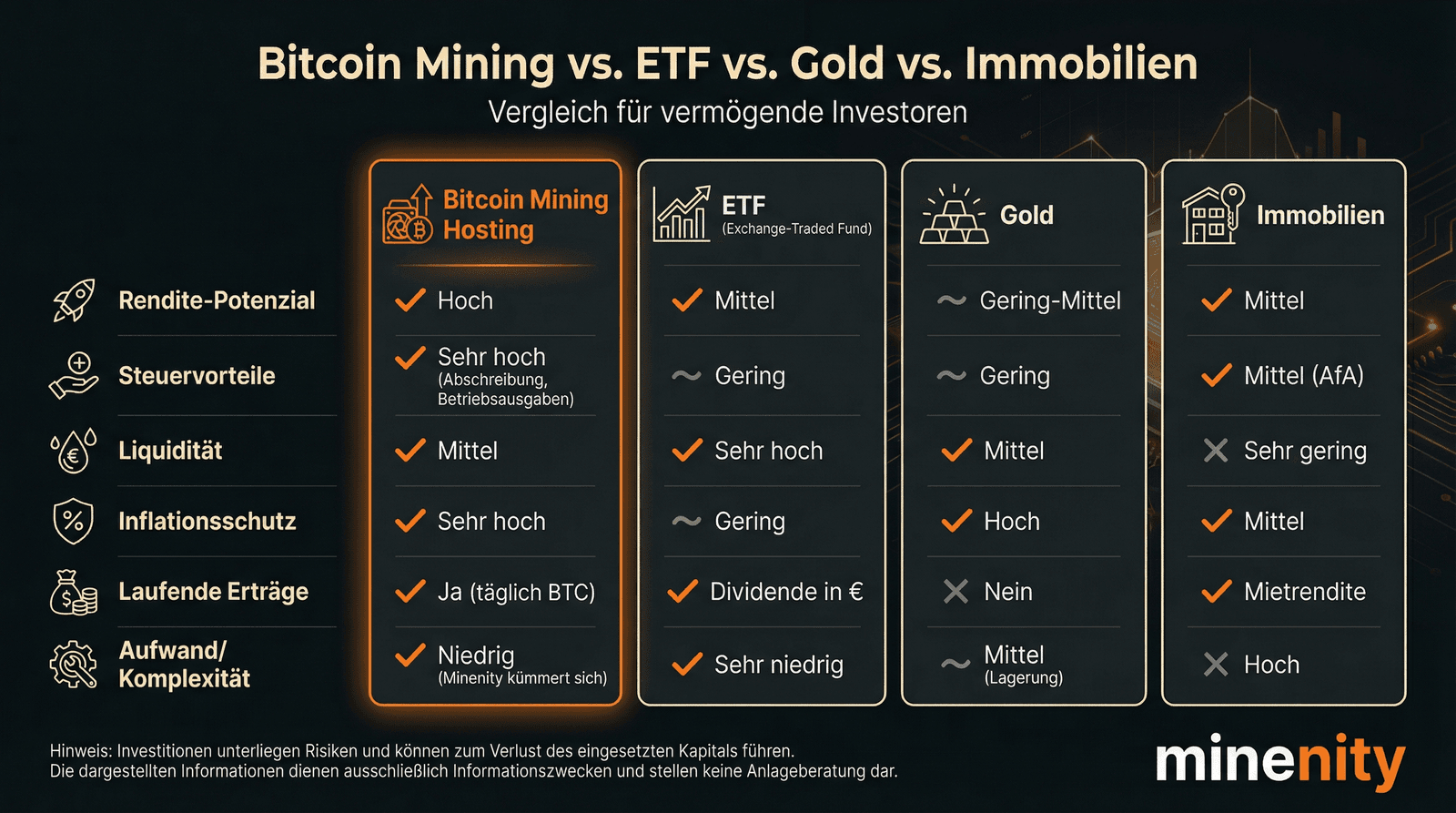
Bitcoin vs. an equity ETF (e.g. MSCI World)
Over the last 20 years an MSCI World ETF has averaged roughly 8 to 10 percent annually — solid performance that protects and grows purchasing power. Over the same period bitcoin, despite its volatility, has delivered notably higher annualized returns.
The decisive difference lies in the quality of supply: an ETF represents shares in companies denominated in inflationary currencies. Bitcoin is programmatically capped at 21 million units: no central bank can expand the supply, and no board can dilute holders.
Mining advantage over ETFs: bitcoin mining produces ongoing returns comparable to a dividend, but paid in a structurally deflationary asset rather than in euros or dollars.
Bitcoin vs. gold
Gold has been a store of value for centuries — and rightly so. But gold has weaknesses that bitcoin doesn't share. Physical gold is hard to store, expensive to insure, and cumbersome to transfer.
Bitcoin inherits gold's value proposition — a fixed supply, no counterparty risk, low correlation to traditional assets — and combines it with the upsides of digital portability and full transparency.
Mining advantage over gold:you can't “mine” gold and at the same time treat infrastructure costs as deductible operating expenses. Bitcoin mining hosting allows both, depending on the legal structure used in your jurisdiction.
Bitcoin vs. real estate
Real estate remains a classic family-office vehicle worldwide. It offers tangible substance, rental income, and depreciation opportunities. But it's illiquid, location-bound, regulation-heavy, and at six-figure or seven-figure ticket sizes often comes with meaningful concentration risk.
Bitcoin mining offers a similar character — physical assets in the form of hardware, ongoing operating revenue, and tax-deductible infrastructure costs — without the location risk, vacancy risk, or property transfer taxes.
The long view: why time horizon decides everything
For high-net-worth individuals and family offices the relevant horizon is rarely shorter than five to ten years. Over that timeframe the risk parameters change considerably.
The halving mechanism: every four years the bitcoin network automatically halves the reward for new blocks. The fourth halving happened in April 2024 — since then only 3.125 BTC are issued per block. The next halving in 2028 will reduce issuance to 1.5625 BTC. Less new supply against equal or growing demand is a price-driving mechanism that has historically led to a new bull cycle every time.
Institutional entry: bitcoin ETFs, corporate balance sheets, sovereign wealth funds, pension funds — this adoption is very unlikely to reverse.
Currency pressure: record sovereign debt globally, structural inflation in many economies, eroding trust in fiat currencies. Bitcoin, as a decentralized, non-inflatable asset, benefits from precisely this environment.
For mining investors that means: anyone who today commits EUR 500,000 or more to professional hosting mining accumulates bitcoin systematically in a phase where supply is historically tight and institutional demand is structurally rising.
The financial dimension: where mining hosting stands out
This part is decisive — and underappreciated by many investors. Bitcoin hosting mining offers operational and financial advantages in a business context that simply don't exist when buying bitcoin directly.
Important note: tax treatment of mining and depreciation of mining hardware varies significantly by jurisdiction (US, UK, EU member states, Switzerland, Canada, Australia, and others). The points below describe the general operational logic. Always consult a qualified tax advisor in your country of residence before structuring a mining investment.
1. Hardware as a depreciable business asset
ASIC miners are physical assets with a defined economic useful life. In most jurisdictions, anyone running mining as a business can depreciate the hardware over its useful life — typically over three years. A miner valued at EUR 4,500 produces roughly EUR 1,500 of annual depreciation, which directly reduces taxable business income.
On a EUR 500,000 hardware investment (around 111 miners) that's roughly EUR 167,000 of deductible depreciation per year over three years. The exact rules — accelerated vs. straight-line, bonus depreciation, Section 179 in the US — depend on your specific tax regime.
2. Operating costs: power, hosting, maintenance
All running costs of the mining operation — electricity, hosting fees, maintenance, insurance, software — are typically deductible as ordinary business expenses. That lowers the effective tax burden on mining revenue and creates a cost efficiency that direct bitcoin purchases simply don't offer.
3. Loss treatment
In a business mining setup, losses — for example during a market phase with low bitcoin prices — can in many jurisdictions be offset against other business income. That's a downside buffer no direct bitcoin investment provides. The exact rules depend on local legislation.
4. Operating through a corporate vehicle
For family offices and entrepreneurial investors, structuring mining through a corporate entity (LLC, GmbH, Ltd, or local equivalents) is often more efficient than holding it personally. Corporate income is generally taxed differently from personal income, and reinvested profits stay inside the entity until distribution. The actual rates and treatment depend entirely on your jurisdiction — talk to your tax advisor about the right structure.
Worked example: a EUR 500,000 hosting investment
To make this concrete, here's a simplified model based on realistic assumptions (as of March 2026):
| Parameter | Value |
|---|---|
| Hardware investment | EUR 500,000 |
| Miners deployed (Antminer S21 XP, ~EUR 4,500/unit incl. ancillary costs) | ~111 units |
| Hashrate per miner | ~270 TH/s |
| Total hashrate | ~30 PH/s |
| Total power draw | ~388 kW |
| Monthly power cost (EUR 0.062/kWh) | ~EUR 17,300/month |
| Annual power cost | ~EUR 207,000 |
| Network hashrate (March 2026 assumption) | ~800 EH/s |
| BTC price (conservative) | EUR 65,000 |
| Pool fee | 2 % |
| Monthly mining yield | ~0.50 BTC/month |
| Annual mining yield | ~6.0 BTC/year |
| Annual revenue in EUR | ~EUR 390,000 |
| Less annual power cost | ~EUR 207,000 |
| Net pre-tax revenue | ~EUR 183,000/year |
Note: these numbers are simplified model values for illustration. Actual yields depend on bitcoin price, mining difficulty, network hashrate, and electricity costs and may vary significantly. Mining difficulty trends upward over time, which reduces yield per terahash. Additional hosting fees may apply on top of the power cost. Use our bitcoin mining calculator for an individual model.
The financial leverage: when run as a business, hardware depreciation (~EUR 167,000/year over three years) and all ongoing operating costs are typically deductible. The effective tax burden therefore drops materially compared to a purely private investment — exact figures depend on your jurisdiction and corporate structure.
Why professional hosting is the decisive factor
The biggest mistake new investors make is assuming mining is a do-it-yourself project. That may work for a small basement setup powered by surplus solar. For investments above EUR 100,000, professional hosting isn't optional — it's where the margin lives.
The reasons are simple: power costs make the difference. European households and small businesses pay between 30 and 40 cents per kilowatt-hour. Our data centers in the US and Asia operate at EUR 0.062/kWh — between one fifth and one sixth of European retail rates.
On top of that: professional cooling, 24/7 monitoring, optimized network connectivity, and repair and maintenance handled by experienced technicians. An ASIC miner running 90 instead of 97 percent of the time produces noticeably less bitcoin.
Minenity provides European contracts, personal advice, and transparent billing — with a European contract partner, proper invoicing, and a single point of contact who understands your investment.
Who is bitcoin hosting mining suitable for?
Not everyone. But there's a clear profile where hosting mining makes structural sense:
High-net-worth individuals with liquid funds from EUR 100,000, who treat bitcoin as part of a diversified asset allocation and bring a long-term perspective.
Family offices looking for an alternative allocation that correlates neither with real estate nor with equities, while combining real substance (hardware) with ongoing revenue.
Entrepreneurs and self-employed investors who structure mining through a corporate entity and want to make use of business expense deductions and corporate income tax rates that differ from personal income tax in their jurisdiction.
Long-term bitcoin conviction investors who want to accumulate at production cost rather than at the spot price.
What it isn't: a short-term speculation play. If you expect monthly gains in EUR and would sell at the next market correction, you're better served by a direct bitcoin allocation. Mining hosting is an infrastructure investment with a horizon of at least two to three years.
Conclusion: strategic accumulation in a structural bull market
Bitcoin in March 2026 isn't cheap, but it's well below its all-time high — and for strategic investors that's what counts. The structural drivers (institutional demand, halvings, supply tightening, global currency uncertainty) haven't changed; if anything, they've intensified.
Bitcoin hosting mining gives high-net-worth investors a way to participate in this market: systematic accumulation at production cost, room to structure the investment for operational efficiency, real substance in the form of hardware, and a long-term return profile that ETFs, bonds, and precious metals can't replicate.
Anyone starting professional hosting mining today enters the next bitcoin cycle from a solid, professionally managed base.
Last updated: May 2026. All figures are for illustration and do not constitute financial or tax advice. Bitcoin price, mining difficulty, network hashrate, and tax frameworks can change at any time. For your individual situation please consult a qualified tax advisor and financial advisor in your jurisdiction.
More from Bitcoin Knowledge
Interested? Talk to us.
At Minenity we advise entrepreneurs, family offices, and high-net-worth individuals personally. European contracts, transparent billing, and a team that speaks your language.
About the author: Michel Hartleben is the founder and managing director of 21 Strategy GmbH (Berlin) and the brand Minenity. He advises private investors and family offices on bitcoin mining hosting strategy, hardware selection, and treasury allocation.